
Improving wine clarification is not simply a matter of making wine look bright. It is a careful balance between visual brilliance, aroma retention, texture, and long-term stability. Bruce Zoecklein, a respected wine scientist and author, stated, “Clarity is not quality, but lack of clarity may be a quality defect.” This principle remains practical in modern wineries. A clear glass can build confidence, yet excessive treatment may remove valuable aromatic compounds.
Effective wine clarification begins with observation. Measure turbidity before choosing a process. Examine the wine under natural light. Look for haze, sediment, protein instability, or crystal formation. Each problem needs a different response. Bentonite may reduce protein haze, while filtration can remove fine particles before bottling. Cold stabilization may help prevent tartrate crystals. However, every intervention has a cost. It can reduce volume, soften texture, or slightly mute delicate fruit aromas.
Clean equipment matters greatly. A poorly rinsed tank can reintroduce particles after clarification. Temperature also changes performance. Additions should be mixed gently, then monitored through small trial samples. Do not trust appearance alone. Taste the clarified samples beside the untreated wine. Sometimes the brightest sample is not the best one. This is where practical experience becomes important, and where mistakes can teach more than a perfect trial. Wine clarification should protect the wine’s identity, not erase it. Careful records, laboratory testing, and patience create more reliable results. The process is technical, but judgment still matters.
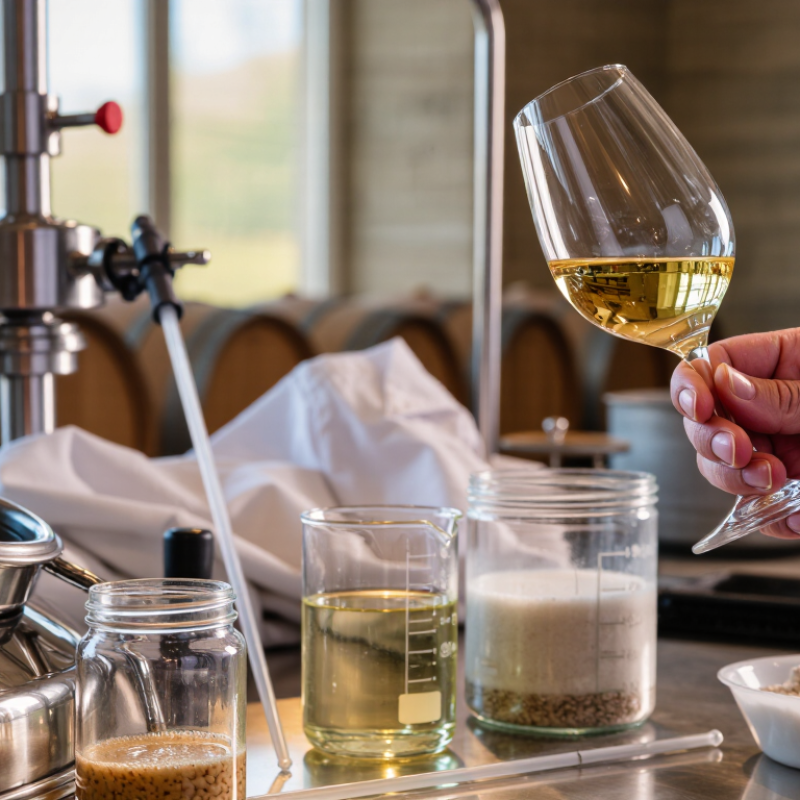
How to Improve Wine Clarification for Better Quality?
Wine clarification should be judged by measurement, not appearance alone. A bright sample can still contain unstable colloids. Turbidity testing gives a more dependable view before bottling. Aim for 1–2 NTU, then verify the result under consistent conditions. Use a clean vial and remove visible bubbles. Mix the sample gently. Temperature changes can affect readings. Calibrate the turbidity meter according to its operating instructions, and record each result with the sample location and time.
Measure after settling, filtration, and tank movement. Measure duplicates. If readings differ sharply, inspect the vial for foam, sediment, or fingerprints. These small details can distort the result. Take samples from the tank outlet, not only from the surface. A single sample may hide uneven clarification. That mistake is easy to make.
Low turbidity does not always guarantee stability after bottling. A simple bench trial can reveal haze risk from proteins, tartrates, or remaining particles. Hold treated samples under controlled conditions, then measure them again. If NTU rises, review fining dosage, contact time, filtration performance, and transfer practices. More treatment is not automatically better. Over-processing can reduce texture or aroma. I have found that rushing the final check creates avoidable uncertainty. The 1–2 NTU target is useful, but the measurement process must also be trustworthy.
Bentonite trials should begin within the typical 20–150 g/hL range. This range is broad for a reason. Grape variety, pH, protein load, and wine age all change the response. A 2023 OIV report estimated global wine production at about 237 million hectolitres. At that scale, small dosing errors can create significant quality losses.
Start with bench samples at 20, 50, 80, 110, and 150 g/hL. Hydrate each dose under identical conditions. Record swelling time, mixing temperature, and contact time. After settling, measure turbidity and protein stability. A clear sample is not automatically a better wine. Excess bentonite may reduce aroma intensity and increase lees volume. That trade-off deserves attention.
Use heat or protein-stability testing where available. The OIV International Code of Oenological Practices recognizes bentonite for protein stabilization, but treatment decisions still require wine-specific trials. Taste the treated samples blind after filtration or simulated clarification. Compare aroma lift, palate texture, and color retention. Keep the lowest effective dose.
Do not trust one trial.
Real cellar conditions can differ from laboratory results. Mixing energy, tank geometry, and bentonite hydration often explain disappointing outcomes. I would also repeat the trial after cold storage, because stability can change over time. A practical record should include dose, wine lot, temperature, turbidity, and sensory notes. That evidence supports consistent decisions and exposes assumptions that may need revision.
How to Improve Wine Clarification for Better Quality?
Optimize Cold Stabilization Near −4°C to −5°C for Tartrate Control
Cold stabilization near −4°C to −5°C can reduce potassium bitartrate crystals before bottling. The exact target depends on alcohol, pH, and dissolved solids. Higher alcohol usually lowers the wine’s freezing point, but temperature control still matters. Do not rely on a thermometer alone.
The OIV Compendium of International Methods evaluates tartrate stability through controlled cooling and conductivity changes. AWRI technical guidance also highlights temperature, potassium concentration, pH, and contact time as critical variables. In practice, many cellars hold wine for several days to two weeks, then confirm stability with a cold test. A filtered sample should remain clear after cooling, warming, and standing.
Small details create visible quality. Keep tanks full, limit oxygen pickup, and avoid disturbing settled lees. Check the coldest tank zone, not only the outlet. Our first trial was too aggressive. The wine became bright, but its acidity felt slightly harder. That result required reflection.
Use laboratory data before extending treatment. A conductivity shift, crystal formation, or unstable sample can reveal incomplete stabilization. Record temperature every few hours. Taste before and after treatment. Clarity is valuable, but balance remains the real quality test.
| Process Dimension | Recommended Operating Range | Purpose in Clarification and Stability | Practical Control Point |
|---|---|---|---|
| Wine temperature | −4°C to −5°C | Promotes potassium bitartrate crystallization while keeping the wine sufficiently fluid for tank treatment and filtration. | Measure the liquid temperature at several tank locations; do not rely only on the refrigeration set point. |
| Cold-contact time | Typically 4–7 days | Allows supersaturated tartrate salts to nucleate, grow, and settle before filtration. | Extend the hold when crystals remain visible or when a stability test still shows precipitation. |
| Wine pH | Common finished-wine range: approximately 3.0–4.0 | Lower pH generally increases the proportion of tartaric acid in its less-ionized form and can influence potassium bitartrate solubility and sensory freshness. | Record pH before and after stabilization; avoid adjusting pH solely to force tartrate precipitation. |
| Potassium bitartrate risk | Higher when potassium and tartaric acid are abundant | Cold stabilization removes unstable potassium bitartrate before bottling, reducing later crystal formation in the package. | Use a cold stability test on a representative sample after treatment. |
| Crystallization aid | Optional potassium bitartrate seeding | Seed crystals can provide nucleation sites and help shorten the time required to reach tartrate stability. | Use only wine-compatible material and follow the supplier’s permitted dosage and mixing instructions. |
| Tank mixing | Gentle, uniform circulation | Improves temperature uniformity and keeps the wine composition consistent throughout the tank. | Avoid excessive agitation, air pickup, and unnecessary oxidation during circulation. |
| Pre-filtration condition | Visible crystals settled; coarse solids reduced | Reduces the solids load on the final membrane or depth-filtration step and supports more consistent flow. | Rack or clarify the wine carefully without disturbing the settled crystal layer. |
| Filtration temperature | Keep the wine cold and consistent with the validated filtration process | Maintains tartrate control after stabilization and helps prevent temperature-related re-dissolution or re-precipitation effects. | Minimize warming between the stabilization tank, filter, and bottling line. |
| Cold stability verification | Hold a representative sample at approximately −4°C to −5°C, then inspect for crystals | Confirms that the selected temperature and holding time are adequate for the specific wine. | Use the same test method, sample volume, and observation time for routine batch comparison. |
| Quality protection | Limit oxygen exposure and unnecessary heat cycling | Preserves aroma, color, freshness, and the visual clarity achieved during stabilization. | Use closed transfers, inert-gas protection where appropriate, and documented temperature monitoring. |
Note: These are typical technical operating ranges for wine production. Actual requirements vary with wine composition, alcohol, pH, potassium concentration, tartaric acid concentration, and equipment. Final settings should be confirmed by laboratory cold-stability testing and sensory evaluation.
Wine clarification is not only about bright appearance. It also protects aroma, texture, and stability during storage. In practical cellar work, I have seen a clear tank sample become hazy after bottling. That result is humbling.
Crossflow filtration can polish wine continuously with limited filter aid use. The membrane retains suspended particles while clarified wine passes through a controlled surface. Keep the feed temperature steady and avoid excessive pump pressure. Harsh flow can strip delicate texture or increase oxygen pickup.
Monitor turbidity before, during, and after the run. A small sample under strong light often reveals fine particles that routine checks miss. Clean the system promptly; dried wine deposits can become stubborn and unpredictable. Crossflow is efficient, but it is not automatically gentle.
For final polishing, a 0.45–0.65 μm membrane can provide a tighter barrier than coarse depth filtration. Choose the pore size after laboratory trials, not by habit. The tighter option may improve visual brightness, yet it can foul faster and reduce throughput. Check compatibility with the wine’s alcohol, acidity, and temperature.
Measure differential pressure, flow rate, dissolved oxygen, and sensory changes. A sterile claim should never be assumed from pore size alone; validate the complete process and local requirements. I once underestimated how much lees remained before polishing. The membrane blocked quickly, wasting time and wine. Pre-clarification matters. Allow enough settling time, then filter only when the wine is genuinely ready.
Clear wine is not automatically stable wine. Before bottling, measure turbidity with a calibrated nephelometer and record the result in NTU. OIV’s State of the World Vine and Wine Sector 2023 estimated global wine production at 237 million hectolitres. At this scale, small quality failures can become expensive. A clear sample should also pass a protein-stability test, such as a controlled heat test. Compare treated and untreated samples, then check sediment, aroma, and colour after resting. AWRI technical guidance recommends bench trials because bentonite dose, contact time, and wine pH can change the result. More treatment is not always better.
Taste it cold.
Tips: Keep a retained bottle from each lot. Inspect it after one week and again after one month. Use the same glass, temperature, and lighting for every comparison. A trained sensory panel should assess bitterness, aroma loss, mouthfeel, and fine sediment. Quantify haze, but do not worship one number. Wine Australia technical resources stress that analytical results should support, not replace, sensory evaluation. My own practical caution is simple: a heat-stable wine may still taste stripped after aggressive fining. Let the wine rest before making the final decision. If the panel disagrees, repeat the trial rather than forcing a clean-looking answer. Cite: OIV, State of the World Vine and Wine Sector 2023; OIV Compendium of International Methods; Australian Wine Research Institute technical guidance.